Make every practice session count.
You put in the reps. See what is improving. RallAIMate Vision is a proposed camera-based training tool that turns practice into a map of where your shots land. Start with a phone, prove the feedback is useful, then offer a dedicated camera, an open training machine and a complete RallAIMate training bay for homes, coaches and clubs.
Back a four-week proof.
A first installment of up to $4,700 funds the first four weeks. Stage A partner funding is $14.7–17.6K over 22 weeks, released in tranches after each review. You bring player access and feedback. The founder funds development in cash and delivers the prototype. Together, we review labeled lab results and a separate 50-ball court session before releasing more capital.
See the funding plan ↓The proposal in one minute.
| Point | Summary |
|---|---|
| What it is | RallAIMate Vision: a camera-based training tool that shows players where their shots land. It starts on a phone, then becomes the Court Pod, one pod with two lenses on a net post. An open training machine and a training bay follow. |
| The decision now | A first installment of up to $4,700 funds a four-week proof. It is part of Stage A, $14.7–17.6K over 22 weeks, released in tranches after each review. |
| What earns the next installment | A 50-ball court session checked against manually marked bounces. Proposed pass line: at least 90% of bounces detected, median placement error under 6 inches, no more than 5 false detections, in two lighting conditions. Both parties sign the record. |
| The full plan | Stage A $14.7–17.6K, Stage B ≈ $17,500, Stage C $106–129K. Alvin's planned cash across all stages is $138–164K. The founder's cash for development is $127–143K. Combined, roughly $265–308K. |
| Proposed ownership, founder / partner | 90 / 10 after Stage A, 80 / 20 after Stage B, 55 / 45 at full funding. A network kicker of +4% to the partner, to 51 / 49, on a signed Palakol agreement and a pro-player drill program. |
| The first product | Court Pod at a $299–349 retail target and a $150 production BOM target. |
| Alvin's role | Player access and feedback, the Palakol conversation, professional players, and the Philippine market. |
| What is not promised | No partner agreement or endorsement is represented as secured. Speed, in/out and kitchen-fault calling are later validation items, outside the funded MVP. |
First, prove players can see their progress.
RallAIMate Vision
The prototype will use a fixed camera to identify the ball and map detected bounces onto the court. The first goal is reliable placement feedback and a shot log. Speed estimates follow only after validation; a single camera needs more than a court-plane mapping to measure an airborne ball. Local processing and optional sharing are design goals.
| Version | Form | When | Hardware |
|---|---|---|---|
| v0 | Phone or webcam on a tripod, browser app | Weeks 1–4 | $0 |
| v1 pod | Net-post pod: CM5 compute with two 90° global-shutter cameras, one facing each half, clamp mount, Wi‑Fi to the Studio app | Weeks 4–8 | ≈ $255–295 |
| v2 | Compute-module redesign, molded shell. Production BOM target ≤ $150 | Pilot / launch | retail $299–349 target |
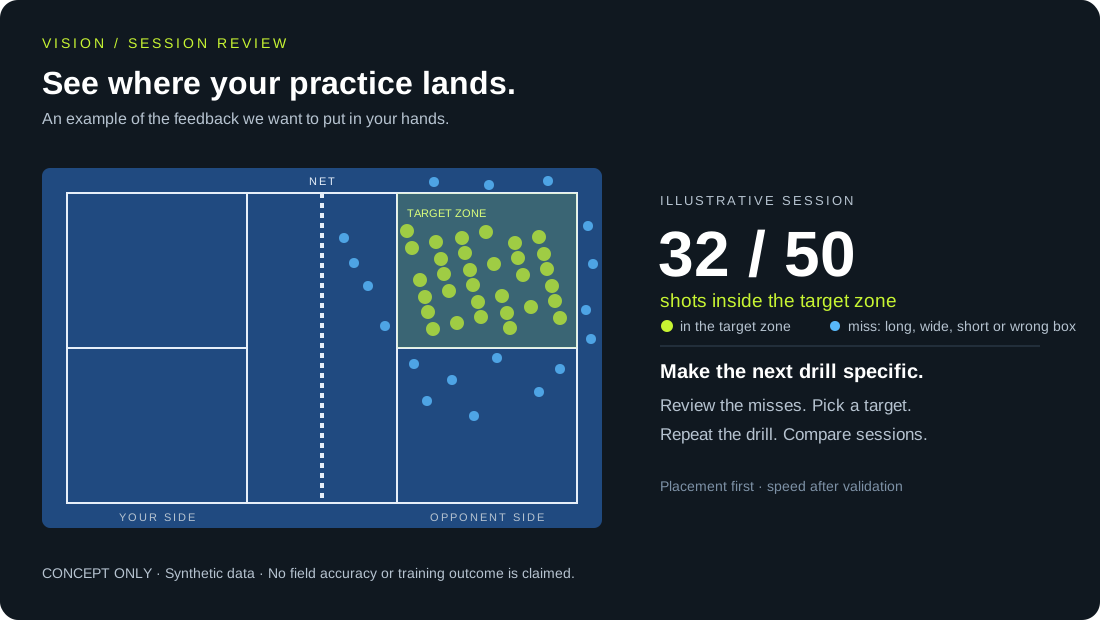
Replay: your practice, shown the way TV shows the pros
The reference is the overlay package on a US Open broadcast: a ball trace drawn onto the court after each shot, a landing mark, target zones that light green on a hit and red on a miss, a position ring, and a speed readout. RallAIMate Replay puts that same language on the player's own practice session, shot by shot, with each clip saved so a session can be scrubbed back one shot at a time.
| Overlay | What the player sees | How we do it | When |
|---|---|---|---|
| Landing mark + bounce ring | A dot where the ball bounced, with a short ring animation | Bounce detected from the tracked trajectory's direction change, mapped to the court through the calibration homography | v0, gated by the lab and court tests below |
| Target zone hit / miss | The zone the drill asked for lights green or red, with the miss distance in feet | The drill engine knows the target; the landing point is compared against it | v0 |
| Ball trace | The shot's path drawn over the video as it happens, then held for a beat | Ball tracked frame by frame on the fixed camera feed | v0 as a 2D trace over video; v1 projected onto the court map |
| Session heatmap | Every landing for the session against the target zones | Aggregated from the per-shot data | v0 |
| Speed readout | mph per shot, session average, fastest | Frame-to-frame displacement at known court scale, checked against a reference instrument | Later stage, after the speed gate |
| Position ring | Where the player stood at contact | Player detection on the same feed | v1 |
Honest scoping: one fixed camera gives a 2D trace over the video and a landing point on the court map. The full mid-air 3D arc the broadcast draws needs a second pod as a stereo pair and is a v2 stretch item, not a v0 promise. The mock above uses illustrative numbers; speed values are shown only to convey the intended experience.
What earns the next tranche?
A result we can check. Record a 50-ball session, manually mark the visible bounces, and compare the prototype’s detections against that record. Review missed shots, false detections, placement error and setup time with the partner.
Proposed acceptance measures: detection coverage, median placement error and repeatability across two lighting conditions. Proposed court thresholds for releasing the next installment: at least 90% of the 50 manually marked bounces detected, median placement error under 6 inches on the court map, no more than 5 false detections in the session, repeated in two lighting conditions. Both parties sign the labeled record before the release. Agree the numbers before the sprint. Speed remains experimental until separately validated.
v1 dev bill of materials (2026 retail, cited)
| Part | Note | Price |
|---|---|---|
| Raspberry Pi CM5 Lite 2 GB Wireless + Nano Base carrier | Pre-certified radio; the same module the pod ships with | $96 |
| 2 × Arducam OV9281 global shutter, 90° lens | One per half; 1280×800 at 120 fps; global shutter avoids rolling-shutter distortion | $52 |
| Clamp mount, case, battery cells, BMS, microSD, PSU, cables | Budgeted as a group | $107–147 |
| Dev unit | ≈ $255–295 |
Why two cameras in one pod: a single pod on one net post then covers both halves, with no second unit to pair or clock-sync. A second pod is the stereo upgrade for speed and arc. The official Pi Global Shutter Camera was set aside because it tops out at 60 fps at full field of view. Heavier option only if a neural model is needed later: Jetson Orin Nano Super dev kit, $399 after NVIDIA's July 2026 price rise. Compute pricing is volatile; the v2 compute-module redesign is how the BOM comes down, and it is budgeted in the cost model below.
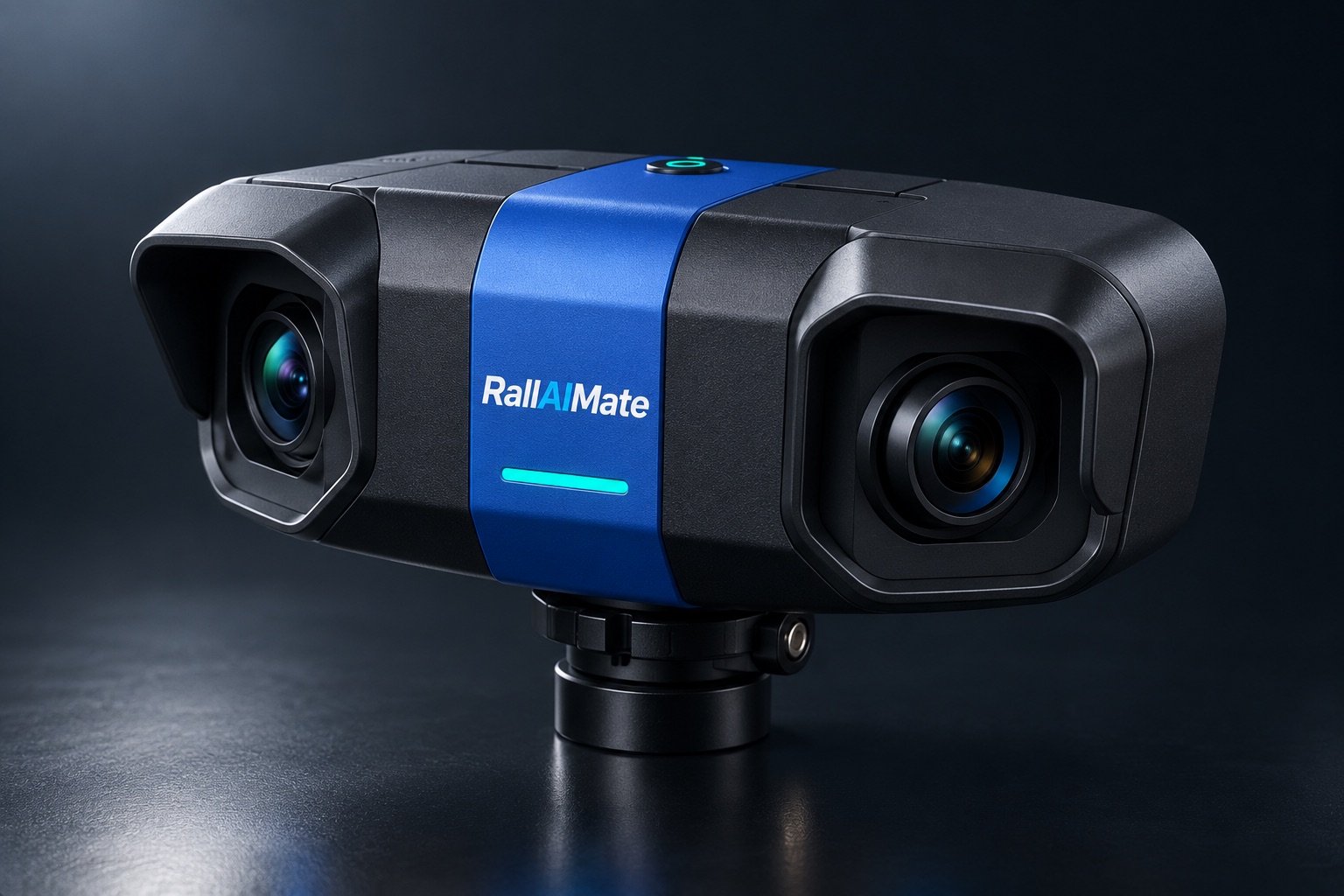
One pod. Two lenses. Both halves.
The v1 unit: two global-shutter cameras in one body on a net-post mast, covering placement and landing points on both halves without a second device to pair. In/out and kitchen-fault calling are later validation items, outside the funded MVP.
$299–349 retail target
at a $150 production BOM; a second pod is the stereo upgrade for speed and arc.
Out of scope on purpose: spin measurement (not achievable with consumer cameras at this budget) and reactive ball-chasing (the $2,000+ tier's moat, low training value per engineering dollar).
A training bay players can bring home.
The proposed RallAIMate Training Bay brings guided pickleball practice into a home, coaching studio or club: a contained hitting space, scored targets and repeatable drills powered by Vision. Our Wesley Chapel lab is the first prototype and demonstration space for that customer offering.
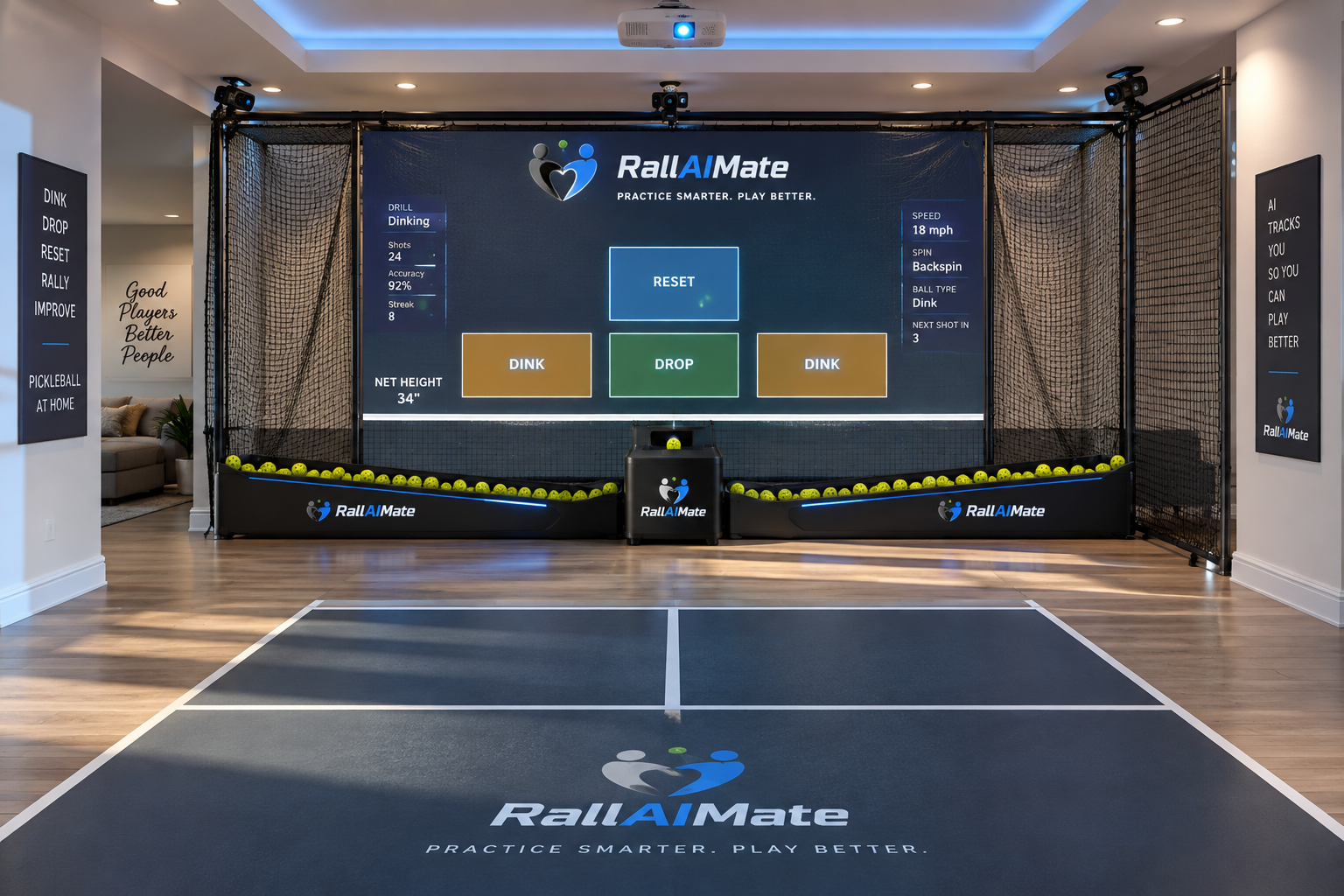
Three ways to buy into the same experience
| Proposed offering | Customer receives | Commercial model |
|---|---|---|
| Range Kit For an existing practice space | Vision pod, marked target sheet, mounting kit and local drill/scoring software. Customer supplies a suitable impact surface or enclosure. | Packaged hardware sale. Bundle price to be set after supplier quotes and testing. |
| Training Bay For homes and coaches | Range Kit plus screen, frame, catch netting, lighting and setup/calibration guidance. Optional projector, court mat, ball machine and return system. | Configured equipment package; installation and calibration quoted separately where available. |
| Club Bay For clubs and training venues | Training Bay configured for coached sessions, branded targets and coach-led drill programs, with an agreed maintenance and support scope. | Site-specific equipment, installation and service quote; venue economics validated in the pilot. |
One software experience across the range. Players choose a target, run a drill and review placement, consistency and streaks. Core scoring is designed to run locally without a required subscription. Projected targets and automated ball feeds are optional upgrades.
Build the intelligence; source the enclosure. Develop Vision, calibration and the drill software in-house. Source screens, frames, netting, projectors and mats from equipment suppliers. Start with made-to-order bay packages and confirm shipping, installation, warranty and support costs before setting a retail price.
The lab rendering illustrates the intended customer experience. The $2,722 lab allowance below uses shared development equipment and is not a customer package price or a production bill of materials.
The first bay is our development lab
Lab proof → court proof → machine integration
| Step | What we demonstrate | Proposed review gate |
|---|---|---|
| Rig & calibration · weeks 1–2 | Camera can see the target and flight path; printed markers map pixels to the screen. | Recorded calibration check and measured target positions. Confirm actual frame rate and exposure on the chosen camera. |
| Target scoring · weeks 2–4 | 200 self-tossed shots labeled inside or outside screen target zones. | Target: ≥95% correct zone classification; median impact-position error below 2 inches. Report worst-case errors and missed events separately. These are proposed lab targets, not achieved results. |
| Drill demo · after scoring gate | Five-minute drill with zones, streaks and a session log; optional projected overlay. | Alvin reviews a recorded drill and the underlying shot log. |
| Court transfer · separate field test | 50-ball session on a real court with manually marked visible bounces. | Agree detection and placement thresholds before testing. A screen result alone does not satisfy this gate. |
| Speed & machine · later stages | Speed checked against a reference instrument, then feed timing integrated with the donor. | Exploratory speed target: ±2 mph over 50 shots, subject to measurement protocol. Spin and automated fault calling remain outside the committed MVP. |
Lab allowance: $2,722 of additional equipment
Use the lean September 13 equipment list as the planning baseline. Reuse the proposal’s existing $600 Vision development allowance for cameras and compute and its $1,100 donor/retrofit allowance for the machine. Confirm those allowances cover the selected configurations before ordering.
| Additional lab item | Planning allowance |
|---|---|
| GoSports 10×8 ft enclosure: steel frame, HD impact screen, side and top netting | $1,000 |
| Side netting, frame extensions, bungees and finish | $150 |
| Practice balls and quiet-ball sample | $162 |
| Tripods, clamps and LED lights | $140 |
| Used short-throw projector, after scoring proof | $350 |
| Basic return troughs, tape and miscellaneous materials | $120 |
| Stalker Sport 3 Connect radar, new, speed ground truth from day one | $800 |
| Incremental lab equipment, before Stage A contingency | $2,722 |
Except the GoSports enclosure ($999.99 list, checked September 18, 2026), lab amounts are inherited planning estimates, not refreshed vendor quotes. Source baseline: $3,052 (the $1,725 list with the radar line raised from $100 used to $800 new and the screen line raised from $373 to $1,000) less the lab list's $180 camera and $150 compute lines, which the two Vision dev units ($600, itemized above) cover = $2,722. Stage A’s existing 15% contingency applies once. Allocate an initial 24 of the existing 100 integration/testing hours to lab setup (planning estimate); re-estimate after the fit check. No separate lab labor is added.
The broader home-build estimate totals $2,400–4,750 for DIY or $7,900–13,700 for the polished concept when its listed rows are summed. Those are alternative scopes, not additional purchases. Printed mats, premium finishes, motorized curtains and campaign-scale upgrades require a later scoped budget.
What Alvin’s support unlocks: a repeatable test setup, a clear record of performance and a demonstration that players can try. The founder provides the proposed home space and builds the system; Alvin helps select useful drills and brings player feedback to the next decision.
Lab sources: Home Trainer Build Context (September 11, with September 13 updates), RallAIMate Project Plan (September 13, §5a), House Open Spaces, and the supplied layout/render images. Purchasing and build completion are not confirmed by these notes.
Vision opens the door. The machine expands it.
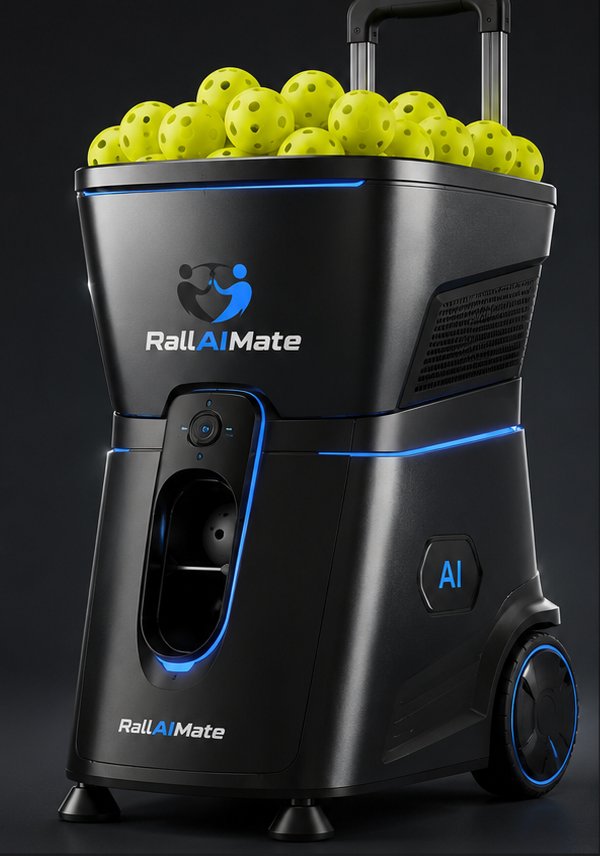
Your practice. Your machine.
A training machine designed around local control, reusable drills and upgradeable parts.
Under $1,000
Machine retail target; final configuration and Vision bundle pricing remain to be validated.
Win on useful feedback, then expand. Start with players and coaches who already have a practice setup. Earn repeat use with Vision before asking them to replace their machine. Current competitor pricing and feature comparisons should be refreshed before external circulation.
The platform: Core (battery, power, base, hardwired e-stop, open controller with REST + WebSocket API, over-the-air updates), Court Head (dual-wheel launcher, independent wheel speeds for spin, motorized elevation and sweep), Studio (browser drill designer and session review, where Vision's heatmaps live), and later Spin and Shuttle heads for table tennis and badminton. Donor for the prototype: a verified 15-year factory, 4.8/5 on 216 reviews, $880 for a single unit (1–5 pieces) and $490 at 6 or more, plus freight. The supplier is not named here to protect the sourcing; the written quote is on file and available to Alvin on request.
Bring your game into practice.
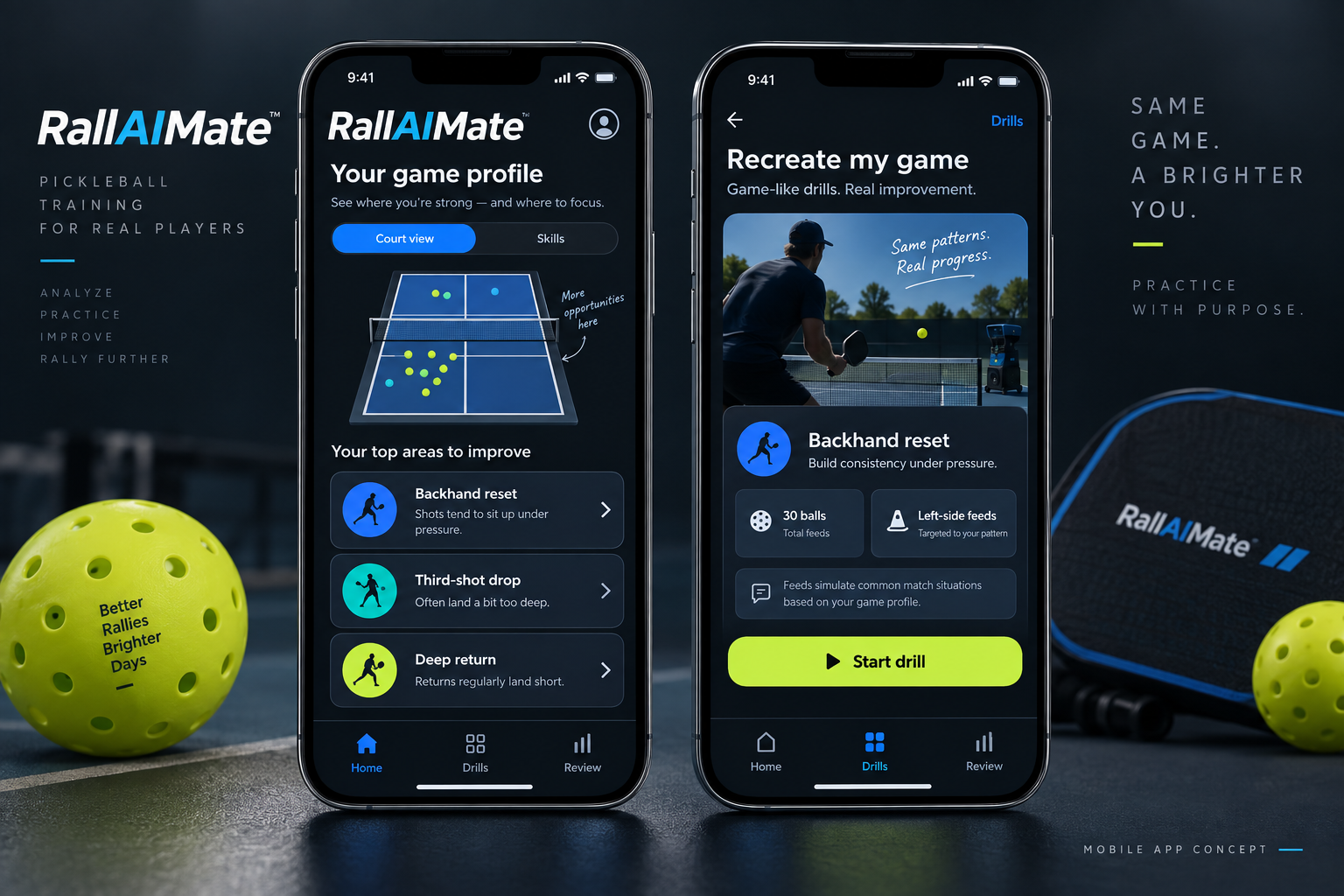
Your missed backhand reset. Your drop that lands too deep. The return that comes up short. Recreate My Game turns those recurring weaknesses into drills you can repeat in a Training Bay or on court.
Build a personal game profile from player observations, coach notes and supported Vision sessions. We use “game handicap” to mean the weaknesses holding a player back; this is a training profile, not an official handicap or competitive rating.
Mobile app: understand, recreate, improve
Apple Watch: keep the session within reach
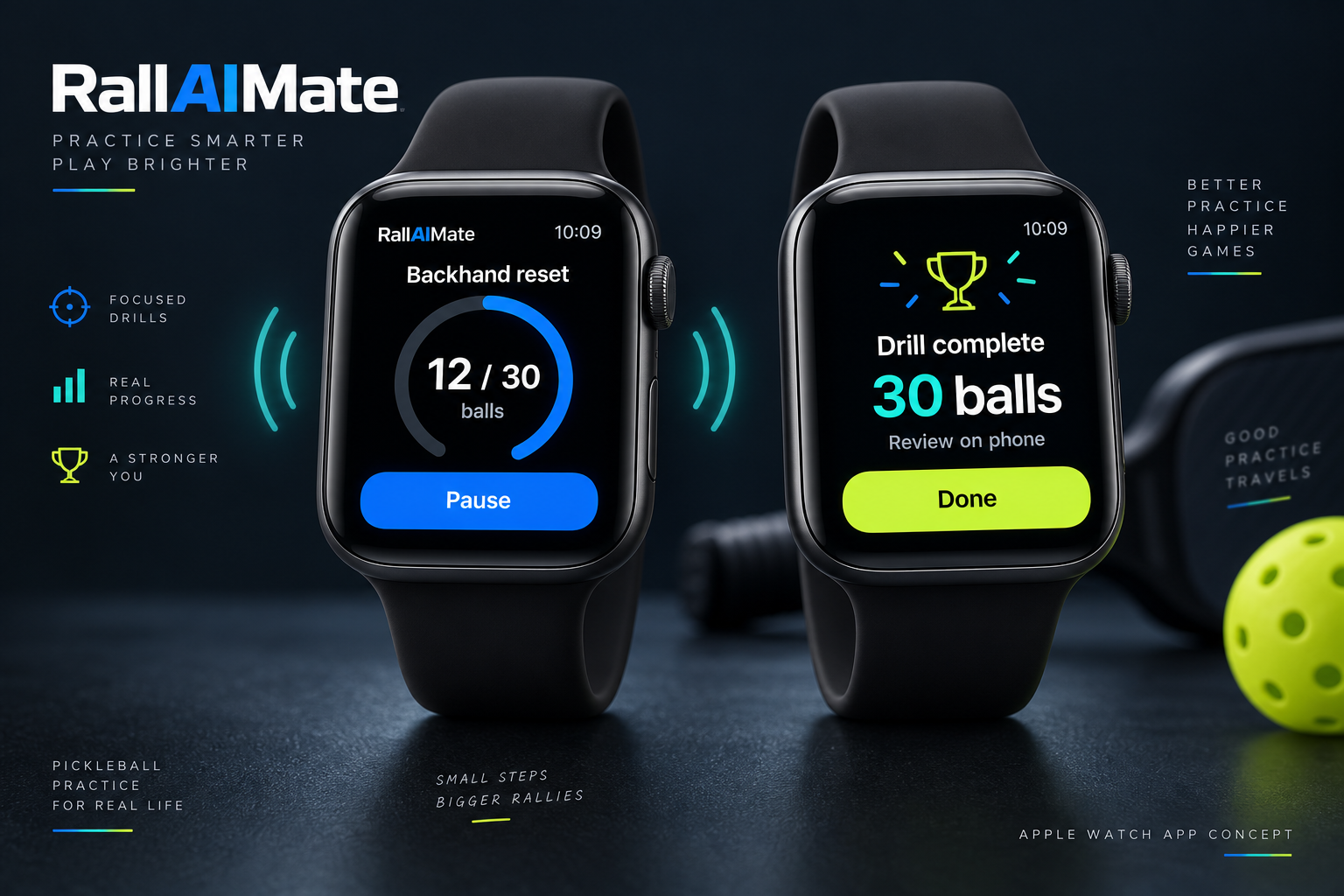
Planned watch controls include start, pause, resume and end, with a readiness confirmation before machine feeds begin. Vibration cues mark set changes and rest intervals; a short summary points back to the phone for detailed review. Test connection loss, delayed commands and supported device combinations before release. The machine’s physical emergency stop remains independent of the app.
From a game weakness to a repeatable drill
- Capture the problem. The player or coach identifies a recurring pattern; later, validated match analysis may suggest candidates from recordings shared with permission.
- Confirm the focus. Example: “My backhand reset pops up under pressure.” The player selects it and records a baseline session.
- Build the drill. Example: 30 left-side feeds in three sets of 10, with a reset target and a controlled feed interval. Choose manual feeding or supported machine settings.
- Recreate the situation. Use the closest supported feed pattern, placement and pace. Show any limits; this is a practice approximation, not an exact replay of an opponent’s trajectory or spin.
- Review and progress. Compare the same test over time, then adjust one variable such as pace or target size. Confirm whether the improvement transfers to subsequent games.
| Game pattern | Practice prescription | Evidence to review |
|---|---|---|
| Backhand reset pops up | Backhand-biased feeds, reset target, three sets of 10 | Screen-target success in range mode; return placement in a separate court test |
| Third-shot drop lands deep | Controlled court feeds and a marked kitchen landing zone | Share of visible bounces in the target, plus misses and tracking coverage |
| Return of serve lands short | Supported serve-like feeds and a deep-return target on a full court | Depth distribution and repeatability; not a compact indoor-bay drill |
Delivery plan and scope
| Stage | Planned experience | Gate and budget treatment |
|---|---|---|
| A · Studio prototype | Phone-friendly browser interface; manually selected weakness, saved drill parameters and session review. | Allocate 40 of the existing 160 Studio hours to this minimal flow, leaving 120 for the drill engine and session UI. Validate that a player can select, run and repeat a drill. Re-estimate if that scope cannot fit. |
| B · Player pilot | Coach-reviewed profiles and repeat-drill comparisons using the same supported setup. | Use existing pilot sessions and allocated testing hours to assess usefulness. Record whether players return to the drill and understand the feedback. |
| Later app release · estimate required | Native mobile app, Apple Watch pairing, watch controls and vibration cues. | Separate implementation estimate for app engineering, device testing, distribution and support before committing a date or funding. These capabilities are not included in the current 1,030-hour labor model. |
| Later intelligence · research gate | Automatic match-pattern suggestions and adaptive drill generation from validated recordings. | Require labeled examples, player/coach review and evidence that suggestions match the observed problem. Additional engineering and data costs remain unbudgeted. |
The founding-partner opportunity: Alvin’s player and coach network helps define the situations worth recreating, validates the drills and can contribute signature training programs. The offering connects game review, practice equipment and personal progress in one experience.
Seven stages. Each one ends with something you can watch or hold.
- 1Vision v0 · weeks 1–4Lab setup, screen-target scoring and phone review, followed by separate court calibration and bounce testing. Proof: 200 labeled lab shots plus a 50-ball court session; report the two results separately. Weeks 1–4 run at about 46 development hours a week (160 v0 hours plus 24 integration hours), a deliberate full-time sprint.$0 Vision hardware; lab gear from the first tranche
- 2Vision v1 pod · weeks 4–8CM5 pod with two cameras, one per half, clamp mount, Wi‑Fi, calibration UI. Proof: pod mounted in a validated fixed position; a pro player's session recorded.2 dev units ≈ $600
- 3Machine brain · weeks 8–16Donor lands around week 6–10. Gut it, open controller, API live. Proof: a phone browser drives speed, spin, elevation, feed.≈ $500–600
- 4Studio · weeks 12–22Phone-friendly drill designer, session log and Vision integration. Recreate My Game starts with a manually chosen weakness and saved feed/target settings. Proof: repeat a personalized drill and compare supported results.software
- 5Mobility · weeks 20–28Mecanum base, preset positions. Proof: machine drives left / middle / right between drills.≈ $150–250
- 6Pilot · weeks 28–4010 branded machines and 10 pods in players' and coaches' hands, US and PH. Use the existing lab for Training Bay trials and seek one external host for a separately costed bay pilot. Proof: field feedback, package preferences and willingness to pay.≈ $17.5K
- 7Launch · week 40+Production run, own enclosure, Vision v2; offer quoted Training Bay packages after the bay pilot gate. Proof: delivered orders and supported customer use.≈ $106–129K
Labor counted, cash staged, nothing hand-waved.
Development labor
Developer rate $110/hr, the documented rate on the founder's current consulting statement of work. Development is treated as an outsourced expense at this rate, paid by the founder in cash; the partner's cash covers hardware, lab, entity, design and launch expenses. Hours are planning estimates to refine together.
| Workstream | Hours | Value |
|---|---|---|
| Vision v0: pipeline, homography, bounce/speed, heatmap UI | 160 | $17,600 |
| Vision v1: pod bring-up, mount, calibration UI, Wi‑Fi | 140 | $15,400 |
| Vision v2: compute-module redesign, BOM reduction | 80 | $8,800 |
| Machine controller firmware + open API | 120 | $13,200 |
| Studio web client + drill engine | 160 | $17,600 |
| Mobility base | 100 | $11,000 |
| Integration, field testing, pilot support | 100 | $11,000 |
| Brand, demo video, launch content | 60 | $6,600 |
| Website & storefront: product site, waitlist and pre-order, checkout, Studio app hosting, API docs, PH storefront listing. Cloudflare Pages, already the live host. | 80 | $8,800 |
| Business entity & compliance admin: formation, operating agreement with counsel, trademark filing, bank and accounting setup, insurance quotes | 30 | $3,300 |
| Development, total planned hours | 1,030 | $113,300 |
| Development already delivered, Aug 21 – Sep 14, 2026 (detailed below) | 120 ≈35 hrs/wk over 3.5 weeks | $13,200 |
| Development, delivered plus planned | 1,150 | $126,500 |
| Industrial design / CAD / enclosure | ~80 | contract, cash below |
Founder's cash by stage
Stage A: $91–103K of founder's cash for development. This comprises 710 planned hours × $110 = $78,100 of new development cost, up to a 15% contingency on hours that mirrors the partner's stage contingency, plus $13,200 for the 120 development hours already delivered between Aug 21 and Sep 14, 2026, at the same $110 rate. Alvin’s Stage A contribution is $14.7–17.6K in cash, starting with a $4,700 installment within that total.
Proposed planning allocation, not a timesheet or earned equity. It distributes the existing 1,030 future hours without adding labor to the total. Stage A runs through week 22; Stage B includes the weeks 23–28 mobility work leading into the weeks 28–40 pilot; Stage C covers production redesign and launch. Stage A averages about 32 hours per week over 22 weeks.
| Workstream | A hours | B hours | C hours |
|---|---|---|---|
| Vision v0 | 160 | 0 | 0 |
| Vision v1 | 140 | 0 | 0 |
| Vision v2 | 0 | 0 | 80 |
| Machine controller + API | 120 | 0 | 0 |
| Studio + drill engine | 160 | 0 | 0 |
| Mobility base | 20 | 80 | 0 |
| Lab setup, integration, testing and pilot support | 40 | 50 | 10 |
| Brand, demo and launch content | 10 | 30 | 20 |
| Website and storefront | 40 | 40 | 0 |
| Entity and compliance administration | 20 | 10 | 0 |
| New development hours | 710 | 210 | 110 |
| New development cost at $110/hr | $78,100 | $23,100 | $12,100 |
| With 15% development contingency | $89,815 | $26,565 | $13,915 |
| Development already delivered, 120 hours (counted once) | $13,200 | $0 | $0 |
| Founder's cash for the stage | $91–103K | $23–27K | $12–14K |
Stage A’s 40 integration/testing hours include the 24 lab-setup hours already allocated. Remaining integration hours are 16 in A, 50 in B and 10 in C. Future website and brand work excludes work counted in the prior-work estimate. IP is included with the work that creates it, with no additional IP valuation. Home lab space and existing tools carry no separate monetary credit. Contractor fees are partner-funded cash, not development hours.
How contributions are earned: record development cost actually paid and accepted milestones, and partner cash actually paid, at each funding review. Future labor and uncommitted cash remain planned contributions. Validate the prior-work credit and agree vesting before issuing equity.
Cash by stage
App scope: the existing Studio budget includes only the browser-based personalized-drill prototype. Native mobile and Apple Watch apps, automatic match analysis and advanced adaptive drills require separate estimates and are excluded from the current cash and founder's-cash totals.
Training Bay commercial rollout: the budget includes the shared lab prototype and its demonstration use. Customer bay inventory, external-site installation, freight and service capacity are not yet costed. Scope and quote the first external bay pilot before committing; update the funding plan if company cash is required. The $138–164K estimate covers the currently costed plan, not a fully funded bay rollout.
Arithmetic revised with the lab allowance. Stage A is $14,688–17,563 including its 15% contingency (rounded to $14.7–17.6K). Stage B is $15,200 of items plus 15% contingency = $17,480 (rounded to $17,500). Stage C: $49K machines + $30K pods + $15–30K tooling + $1–8K testing + $1–2K insurance + $10K marketing = $106–129K. No additional launch contingency is included. Supplier quotes and full compliance scope may increase this allowance.
| Stage | Covers | Cash |
|---|---|---|
| A · Prove it weeks 1–22 | 2 Vision dev units ($600); donor + retrofit ($1,100); mobility parts and spares ($250); lab equipment ($2,722, itemized above); business entity setup ($3,000–5,500, itemized below); website domain, hosting and checkout setup ($100; Cloudflare Pages free tier, already live); contract CAD and industrial design ($5,000); 15% contingency | ≈ $14.7–17.6K |
| B · Pilot weeks 23–40; pilot 28–40 | 10 donors at $490, the supplier's 6+ unit tier, + freight (≈ $5,700); 10 controller kits (≈ $1,200); 10 Vision v1 pods (≈ $2,800); printed parts and branding ($500); pro-player drill program fees ($3,000); US/PH shipping and events ($2,000); 15% contingency | ≈ $17,500 |
| C · Launch week 40+ | First run of ~100 machines at the supplier's $490 tier and ~200 pods at the $150 production BOM target ($49K + $30K); assembly, packaging, freight and duties are not in these unit prices and need factory quotes and a tariff scenario; enclosure tooling ($15–30K); FCC Part 15B testing for the pod ($1,000–8,000); product liability insurance ($1–2K/yr); launch marketing ($10K) | ≈ $106–129K |
| Alvin's planned cash, all stages | ≈ $138–164K | |
Total project value at the end of Stage C: $127–143K of founder's cash for development and $138–164K of Alvin's cash, a combined requirement of roughly $265–308K, of which the founder carries just under half.
Business entity setup
Recommendation: a new multi-member Florida LLC owned by founder and partner per the split below, with an operating agreement that encodes vesting and tranches. Proposed structure for counsel and tax review; governance, IP assignment and any later conversion need written agreement. State and USPTO fees are 2026 published figures; attorney and insurance lines are estimates pending quotes.
| Item | Basis | Cost |
|---|---|---|
| Florida LLC Articles of Organization | Sunbiz fee, includes registered-agent designation | $125 |
| Registered agent | Founder's Florida address, or a service | $0 – $150/yr |
| Florida annual report | Due May 1 every year; $400 late fee | $138.75/yr |
| EIN, Florida sales-tax registration, business bank account | IRS / FL Dept. of Revenue | $0 |
| Operating agreement: vesting, tranches, IP assignment | Attorney | $1,500–3,000 |
| Trademark clearance search | Attorney or service | $500–1,500 |
| USPTO trademark filing, 2 classes (28 sporting goods, 9 software) | $350 per class base fee; surcharges if descriptions are custom | $700 |
| Domain rallaimate.com | Registrar quote in project docs | $13.48/yr |
| Stage A entity total | ≈ $3,000–5,500 | |
| Stage C: FCC Part 15B test for the pod | Planning allowance; a test lab must confirm the complete product’s radio and host compliance scope | $1,000–8,000 |
| Stage C: product liability insurance | Quote pending | $1–2K/yr |
Work already on the table
Between Aug 21 and Sep 14, 2026 the founder delivered: market and competitor research (nine machines priced from brand sites, scam storefronts identified), donor sourcing with a verified factory and a rejected-candidates log, the six-phase build plan, the shared-platform architecture and API design, a bill of materials, the brand system (name, logo, palette, product naming), a project documentation set, and a live website on Cloudflare Pages. Planning estimate of 120 hours (not an audited timesheet) × $110 = $13,200, counted once in Stage A development below.
What the partner actually risks: the proposed first tranche is capped at $4,700 within Stage A. Reserve $600 for Vision development hardware, $1,100 for the donor machine and retrofit, $2,372 for lab equipment with the projector deferred, and $628 (15%) for shipping, taxes and overruns. The projector ($350) is deferred until its validation stage. The radar ($800, Stalker Sport 3 Connect, bought new) is required from the start as the speed reference instrument. This first $4,700 is part of Stage A, not an additional budget. Defer legal and CAD commitments beyond that cap until the next funding decision. Later tranches require mutual written approval; do not place additional orders before that approval.
A partnership built around clear contributions.
Discussion terms, not a valuation or executed offer. The first table compares what each side puts in during a single stage. The second adds the stages up and sets cumulative contributions beside the proposed ownership after that stage. Development already delivered is counted once, in Stage A. The equity percentages are proposed negotiation terms, not an automatic conversion of contribution values. Stage-specific vesting and contribution records must be agreed before any equity is issued.
Founder funds development in cash and contributes the work to date and the IP. Partner contributes cash and network. Founder keeps product and engineering; partner leads the Philippine market, athlete relations and the Palakol partnership.
Stage by stage: what each side puts in
| Stage | Partner cash this stage | Founder's cash this stage | Modeled split, this stage founder / partner |
|---|---|---|---|
| Stage A · Prove it | $14.7–17.6K | $91–103K | 88 / 12 to 84 / 16 |
| Stage B · Pilot | ≈ $17.5K | $23–27K | 61 / 39 to 57 / 43 |
| Stage C · Launch | $106–129K | $12–14K | 12 / 88 to 9 / 91 |
Founder's cash is development at $110/hr: planned hours with the 15% hours contingency, plus the 120 hours already delivered, counted once in Stage A. Stage C is partner-heavy by design: production cash arrives after the software is largely built.
Cumulative: contributions versus proposed ownership
| After stage | Partner cash cumulative | Founder's cash cumulative | Modeled cumulative split founder / partner | Proposed equity after this stage |
|---|---|---|---|---|
| A · Prove it | $14.7–17.6K | $91–103K | 88 / 12 to 84 / 16 | 90 / 10 |
| A + B · Pilot | $32–35K | $114–130K | 80 / 20 to 77 / 23 | 80 / 20 |
| A + B + C · Launch | $138–164K | $127–143K | 51 / 49 to 44 / 56 | 55 / 45 |
Modeled splits use the displayed rounded budgets and round to whole percentages. Proposed equity is the ownership position once that stage is funded, not a per-stage grant. The $4,700 first installment does not by itself earn the full Stage A partner allocation. The existing 90/10, 80/20 and 55/45 proposals remain discussion terms; Stage A’s proposed 10% differs from the modeled 12–16% cumulative share and needs explicit agreement.
Why propose 55/45: the founder carries execution risk and funds 1,000+ development hours over a year in addition to the development already delivered; the partner's capital is milestone-released, so downside is capped at every stage. Terms to agree:
A partner who plays, and who knows the players.
Two-market thesis. Design and prove in Tampa Bay, manufacture in Asia, launch in the US direct and in the Philippines through a brand players already trust. You are the bridge.
Vision, machines and training bays.
Initial customers to test: frequent players adding Vision to an existing setup; homeowners and coaches buying a Training Bay; and clubs adding a dedicated practice station. Alvin’s network can introduce pilot users and prospective host venues. Validate repeat use and willingness to pay for each package before production.
Vision economics to validate
At a $299–349 retail target and a $150 production BOM target, the spread is $149–199 per pod (50–57% of retail) before assembly, freight, duties, payment fees, warranty, support and channel margins. This is not a gross-margin forecast.
| Line | Model | Why it works |
|---|---|---|
| Vision pod | Hardware sale, target $299–349; optional pro drill packs | First intended product; validate supported setups, repeat use and willingness to pay. |
| Range Kit & Training Bay | Hardware kits and configured equipment packages; optional projection, machine and ball-return upgrades | The lab becomes the first customer demo. Price each package from its delivered and supported cost. |
| Club Bay & services | Site packages, installation/calibration and optional maintenance or coach programs | Pilot with a host venue; validate utilization, support workload and repeat purchases. |
| Machines | Direct sale under $1,000 | Target price and margin require supplier quotes and a final feature set |
| Conversion kit | Controller + printed parts for $150–400 used tennis machines | Small hardware kits; inventory, support and compatibility costs still apply |
| Upgrade kits | Brushless motors, mobility base | Natural upsells on an open platform |
| Personalized drills & coaching content | Core saved drills and local review; optional signature programs and coach/club licensing | Recreate My Game connects recurring game weaknesses to repeatable practice. Premium program pricing and demand remain to be tested. |
| Bundles & co-brand | Pod or machine + paddle; club and venue packages | Direct fit for Palakol |
| Multi-sport | Table tennis and badminton heads on the same Core | Same firmware, new markets |
| Risk | Mitigation |
|---|---|
| Vision accuracy in real light and clutter | Begin with controlled lab targets, then test on a real court across lighting conditions. Release larger hardware commitments only after the relevant gate passes. |
| Compute prices stay high | v2 compute-module redesign is budgeted; pod price set after the BOM is proven. |
| Crowdfunded competitors ship at $499–999 | Validate demand for feedback and local control against current alternatives before committing to production. |
| Tariffs on Chinese-made hardware | Imported electronics and machines may be exposed. Model tariffs and landed costs before Stage C. |
| Trademark collision | Formal clearance is a Stage A line item before public use. |
| Donor underperforms | Five verification questions before purchase; motor upgrade path designed. |
| Training Bay delivery and support costs | Validate space requirements, containment, installation time and delivered margin in a host-site pilot before selling a standardized package. |
| Game-profile accuracy and app scope | Start with player/coach-confirmed weaknesses. Validate automatic analysis separately; cost native apps and watch integration before promising availability. |
| Solo founder bandwidth | This partnership, plus contract CAD in the budget. |
If we agree
- Sign a term sheet on the share structure above; release Stage A tranche 1.
- Vision v0 sprint starts: set up the dining-room lab, calibrate the target panel and test impact detection with self-tossed balls. Then validate court bounces in a separate field session.
- Order the donor machine (blocked only on seller answers; 4–6 week delivery) and two Vision dev units.
- Confirm domain ownership and renewal, run formal trademark clearance.
- You open the Palakol conversation, line up the first pro player for a recorded session, and introduce a coach or venue to review the Training Bay offering.
- Week 4 review: lab scoring evidence, a five-minute drill if the scoring gate passes, and the separate court-session results.